Le prix de l’essence est-il un levier pour favoriser l’usage des mobilités actives et des transports publics ?

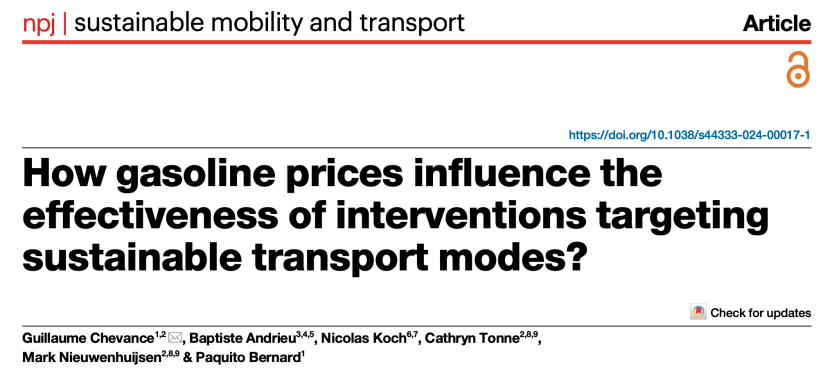
Avec une belle équipe interdisciplinaire, nous nous sommes intéressés au rôle du prix de l’essence dans l’efficacité des interventions visant un report modal de la voiture vers des modes de transport actifs et publics.

Nous mettons en évidence que, si la hausse du prix de l’essence favorise dans certains cas l’abandon de la voiture au profit de modes de transport plus sains et durables, cela n’est possible qu’à la condition que les territoires aient investi dans des infrastructures offrant des alternatives crédibles à la voiture.

L’article ci-dessous synthétise les principaux enseignements issus de notre étude, en accès libre ici.
Continuer à lire … « Le prix de l’essence est-il un levier pour favoriser l’usage des mobilités actives et des transports publics ? »

Teaching open science to epidemiologists

In May 2024, I delivered a practical, 4-hour course on open science to epidemiologists at ISGlobal. I’m sharing my slides here in case they may be useful to others. During the course, we explored the replication crisis and its underlying causes and reviewed potential solutions. These included best practices for sharing code and data, using pre-prints, publishing null results, pre-registration, and registered reports, among other strategies.

Open science is still a relatively new thing in epidemiology (sadely!) compared to fields like psychology and biology. I’ve personally experienced reluctance many times when discussing preprints or data/code sharing with colleagues from epidemiology. Let’s be optimistic, things should change.

Special thanks to Matthieu Boisgontier, that gave a talk some years ago that inspired me a lot.

Continuer à lire … « Teaching open science to epidemiologists« 

Parler du changement climatique en STAPS : retour d’expérience

Je viens de passer deux fois trois heures dans un amphithéâtre avec des étudiants de master en sciences et techniques des activités physique et sportives (STAPS) à parler de changement climatique (merci à leur responsable de parcours, Eric Fruchart, pour l’opportunité) ; au programme : rapport du GIEC, liens entre la pollution de l’air, l’activité physique et le sport ; la question des conditions météorologiques extrêmes et les catastrophes naturelles ; mais aussi les émissions de GES associées au sport et le problème du « green washing » dans le milieu du sport. Mon diaporama est en accès libre ici. Je livre dans cet article un bref retour d’expérience.

Continuer à lire … « Parler du changement climatique en STAPS : retour d’expérience« 

Video: a presentation of our last systematic review about heat and sleep

A tweny minutes presentation of our last systematic review about the impact of heat on sleep. Earlier reviews documented the effects of a broad range of climate change outcomes on sleep but have not yet evaluated the effect of ambient temperature. This systematic review aims to identify and summarize the literature on ambient temperature and sleep outcomes in a warming world.

Continuer à lire … « Video: a presentation of our last systematic review about heat and sleep »

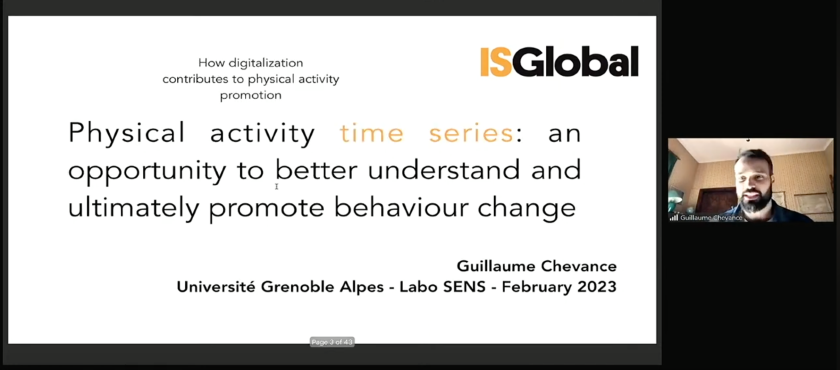
Video: why do we need time series (analyses) to better promote physical activity behavior change

Seminar I had the pleasure to gave to the SENS Lab, Grenoble, France, as part of their workshop on digital health and physical activity promotion. It’s about time series and why they are crucial to better understand and promote behavior change!

I’m talking about sampling frequency, getting closer to peoples’ real life, my opinion on physical activity maintenance (now that I am into time series), early warning signals and other things + my take home messages at 27’40!

Continuer à lire … « Video: why do we need time series (analyses) to better promote physical activity behavior change »

Climate change and health behaviors: how are they both shaping each other’s?

When we think about how climate change impact our health the first things that probably popped-up is the effect of air pollution or heat stresses on mortality and hospitalizations. It’s normal, these topics are, by far, the most studied ones in the scientific literature. Our new article goes beyond these traditional outcomes and provide a literature review and framework to study how climate change is impacting our health behaviors and, the other way around, how a smart promotion of health behaviors can help mitigate and adapt to climate change. Presentation below.

Continuer à lire … « Climate change and health behaviors: how are they both shaping each other’s?« 

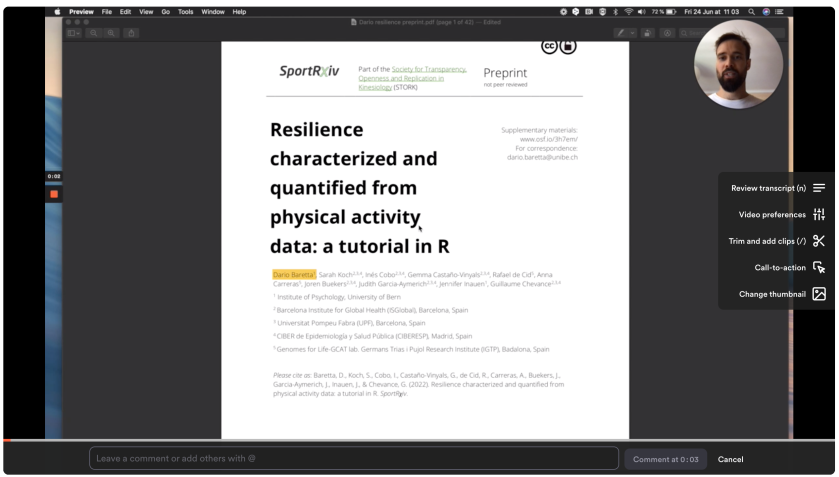
Vlog #1: R tutorial to characterize the resilience process from physical activity data

I am trying a new vlog format to briefly (5 minutes!) present a tutorial that we just released with colleagues from Barcelona and Bern about the quantification of the so-called resilience process with physical activity time series.

Continuer à lire … « Vlog #1: R tutorial to characterize the resilience process from physical activity data »

Video seminar for the Centre for Behaviour Change: it’s about methods!

New seminar I had the pleasure to gave to the Centre for Behaviour Change from the University College London in June 2021. It’s about methods for improving behavior change science. The talk is based on an article we published a year ago (here). See below for the video (~20-min)!

Continuer à lire … « Video seminar for the Centre for Behaviour Change: it’s about methods! »

Why is the digital (health) system not sustainable?

I was recently invited to give a talk and an interview to a special interest group on ethical considerations in digital health research, led by University College London researchers Dr Olga Perski, Dr Melissa Oldham and Dr Claire Garnett. See the talk and interview below. It’s about the environmental impact of digital health.

Continuer à lire … « Why is the digital (health) system not sustainable? »

Activité physique, sport et changement climatique

Ces derniers mois, j’ai eu la chance de participer à plusieurs initiatives collectives visant à mieux comprendre les relations entre activité physique, sport et changement climatique. Je vous ai préparé une brève compilation d’articles ci-dessous pour mieux comprendre les enjeux.

Continuer à lire … « Activité physique, sport et changement climatique »